
Low-code and no-code platforms have emerged as game-changers in the software development landscape, enabling individuals with varying technical skills to create applications effortlessly. These platforms eliminate the need for extensive coding knowledge, allowing users to focus on creativity and functionality instead of intricate programming languages.
From small businesses to large enterprises, organizations are embracing these tools for their ability to streamline processes, enhance collaboration, and drive innovation. Popular platforms like Airtable, Zapier, and Bubble illustrate the versatility and accessibility of low-code and no-code solutions, making technology more approachable for everyone.
Low-Code and No-Code Platforms Overview
Low-code and no-code platforms have emerged as transformative tools in the realm of software development. They empower individuals with varying technical skills to create applications without extensive programming experience, significantly accelerating the development process and broadening access to digital innovation.Low-code platforms require some coding knowledge, allowing users to drag and drop components to design applications while still providing opportunities for customization through code.
In contrast, no-code platforms eliminate the need for any coding, enabling complete application creation using visual interfaces and pre-built templates. These platforms aim to simplify development for business users, also known as “citizen developers,” who can address their own needs without relying solely on IT.
Popular Platforms in the Market
Several platforms have garnered popularity for their user-friendly interfaces and robust functionalities. Examples include:
- OutSystems: A low-code platform that supports enterprise-grade applications, focusing on speed and integration capabilities.
- Mendix: This low-code platform emphasizes collaboration and offers tools for both developers and business users.
- Bubble: A no-code platform that allows users to build fully functional web applications without programming knowledge.
- AppSheet: A no-code platform, now owned by Google, aimed at enabling users to create mobile applications based on data from various sources.
- Zapier: This automation tool allows users to connect different apps and automate workflows without writing code.
Advantages and Disadvantages of Using These Platforms
Utilizing low-code and no-code platforms comes with distinct benefits and challenges that should be considered.The advantages include:
- Speed of Development: Applications can be created and deployed much faster than traditional development methods.
- Cost Efficiency: Reduced development and maintenance costs due to less reliance on specialized coding skills.
- Empowerment of Non-Technical Users: Encourages innovation by enabling employees closer to business operations to contribute to application development.
- Flexibility: Adapts easily to changing business needs and allows quick iterations based on user feedback.
However, there are notable disadvantages:
- Limited Customization: While low-code platforms allow for some coding, there may be restrictions compared to fully custom-built solutions.
- Vendor Lock-In: Organizations may become dependent on a specific platform, making it difficult to migrate applications or data.
- Security Risks: High levels of access for non-technical users may lead to potential security vulnerabilities if not managed properly.
- Integration Challenges: Connecting with existing systems and databases may pose difficulties, particularly for complex environments.
Applications of Low-Code and No-Code Platforms
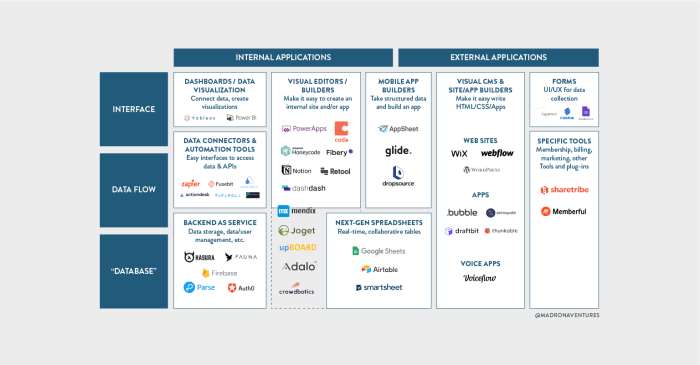
Low-code and no-code platforms have emerged as transformative tools across various industries. Their ability to democratize development allows a broader range of individuals, from business analysts to project managers, to contribute to the creation of software solutions. This transition not only accelerates project timelines but also fosters innovation by enabling teams to iterate quickly and respond to changing business needs.Different industries benefit significantly from low-code and no-code development due to its adaptability and efficiency.
Key sectors leveraging these platforms include:
Industries Leveraging Low-Code and No-Code Development
Several industries have successfully integrated low-code and no-code platforms into their operations. These platforms streamline processes, enhance productivity, and reduce dependency on traditional software development cycles. Here are some notable examples:
- Healthcare: Low-code platforms have been utilized to develop applications that manage patient records, schedule appointments, and facilitate telehealth services, significantly enhancing patient care and operational efficiency.
- Finance: Financial institutions leverage no-code tools to create customer-facing applications for account management and loan applications, allowing for rapid deployment and compliance with regulatory changes.
- Retail: Retail businesses have adopted low-code solutions to improve inventory management and customer engagement through personalized shopping experiences, resulting in increased sales and customer satisfaction.
- Education: Educational institutions utilize no-code platforms to build learning management systems (LMS) that facilitate online learning, enabling educators to create and manage courses easily.
Case studies further illustrate the success of these platforms. For instance, a leading healthcare provider implemented a low-code solution to enhance their patient management system. By doing so, they reduced the time spent on administrative tasks by over 30%, allowing healthcare professionals to focus more on patient care.
Success Stories Illustrating Use of Low-Code and No-Code Platforms
Numerous organizations have shared their success stories after adopting low-code and no-code platforms. These stories showcase how these platforms lead to significant operational improvements and innovation.
“We built an inventory tracking app using a no-code platform in just a few days. It transformed our supply chain management and reduced errors dramatically.” – Supply Chain Manager at a Retail Company
Another compelling example is a financial services company that used a low-code platform to develop an automated loan processing system. This solution cut down processing time from several days to mere hours, improving customer satisfaction and driving growth.
Enhancing Collaboration Between Technical and Non-Technical Teams
One of the most profound impacts of low-code and no-code platforms is their ability to bridge the gap between technical and non-technical team members. By providing user-friendly interfaces and simplifying development processes, these platforms foster collaboration and communication.The integration of visual development tools enables non-technical users to contribute effectively to the development process, while technical team members can focus on more complex programming tasks.
This collaborative environment leads to:
- Faster Iteration: Non-technical users can propose changes and improvements in real-time, resulting in quicker feedback loops and more responsive project management.
- Empowerment of Business Users: Business analysts and other non-technical staff can create applications that meet their specific needs without always relying on IT departments.
- Enhanced Team Dynamics: By working together, technical and non-technical members build better understanding and trust, encouraging innovation and creative problem-solving.
As a result, organizations can adapt more swiftly to market demands, ultimately leading to greater business agility and success.
Future Trends in Low-Code and No-Code Development
The landscape of low-code and no-code development is rapidly evolving, driven by technological advancements and changing business needs. As organizations strive for agility and efficiency, these platforms are gaining traction as viable alternatives to traditional software development approaches. This section explores the emerging trends that are shaping the future of low-code and no-code solutions.
Emerging Technologies Influencing Low-Code and No-Code Platforms
Several cutting-edge technologies are enhancing the capabilities of low-code and no-code platforms. These advancements ensure these solutions become increasingly robust, user-friendly, and versatile.
- Artificial Intelligence: AI is being integrated into low-code and no-code platforms to automate tasks and provide smart suggestions. This allows users to create applications more intuitively and quickly.
- Machine Learning: Machine learning algorithms are being utilized to analyze user interactions and improve the user experience, making it easier to build applications that meet specific user needs.
- Natural Language Processing: This technology enables users to create applications through conversational interfaces, reducing the reliance on coding knowledge.
- Blockchain: Blockchain technology is beginning to see use in low-code solutions, particularly in sectors where security and transparency are paramount, such as finance and supply chain management.
- Internet of Things (IoT): Low-code platforms are increasingly being designed to integrate with IoT devices, allowing for the collection and analysis of data from smart devices seamlessly.
Growth Comparison with Traditional Software Development Methods
The growth trajectory of low-code and no-code development platforms starkly contrasts with traditional software development processes. While traditional methods are often lengthy and resource-intensive, low-code and no-code solutions are designed for speed and efficiency.
“The low-code/no-code market is projected to grow from $13.2 billion in 2020 to $45.5 billion by 2025.”
The increasing demand for digital transformation is a primary driver of this growth. Organizations aim to reduce development time and costs, enabling faster responses to market changes. This shift is evident in sectors such as finance, healthcare, and retail, where rapid application deployment is critical.
Impact of AI and Automation on Future Platforms
Artificial intelligence and automation are poised to play a significant role in the evolution of low-code and no-code platforms. These technologies streamline development processes and enhance the overall functionality of applications.
- Enhanced Automation: Automation features allow users to set up workflows without coding, significantly reducing the time required to build and deploy applications.
- Improved Testing and Quality Assurance: AI-driven testing tools are making it easier to ensure applications function correctly before deployment, enhancing reliability and user satisfaction.
- Predictive Analytics: AI capabilities enable platforms to provide insights based on user behavior, allowing for more tailored applications that adapt over time.
- Integration with Existing Systems: Automation simplifies the integration of new applications with legacy systems, a challenge traditionally faced in software development.
With these advancements, low-code and no-code platforms are not just a trend but are transforming how applications are developed and deployed, making technology more accessible to non-technical users and fostering innovation within organizations.
Last Recap
In summary, low-code and no-code platforms are paving the way for a future where app development is accessible to all, regardless of technical expertise. As these platforms continue to evolve, they will reshape workflows, foster collaboration, and lead to unprecedented levels of productivity and creativity across various industries.
Clarifying Questions
What are low-code and no-code platforms?
These are development tools that allow users to create applications with minimal or no coding, utilizing visual interfaces and pre-built components.
Who can benefit from using these platforms?
Both technical and non-technical users can benefit, as these platforms empower business analysts, marketers, and other professionals to develop apps without heavy programming knowledge.
Are there any limitations to low-code and no-code platforms?
Yes, while they offer ease of use, they may also have limitations in customization, scalability, and integration with complex systems compared to traditional coding.
How do low-code and no-code platforms enhance collaboration?
They allow cross-functional teams to work together more effectively by providing tools that everyone can use, bridging the gap between technical and non-technical members.
What trends are shaping the future of these platforms?
Emerging technologies like AI, machine learning, and automation are greatly influencing the capabilities and functionalities of low-code and no-code platforms.


